What Is an EPK? A Musician's Guide to the Electronic Press Kit
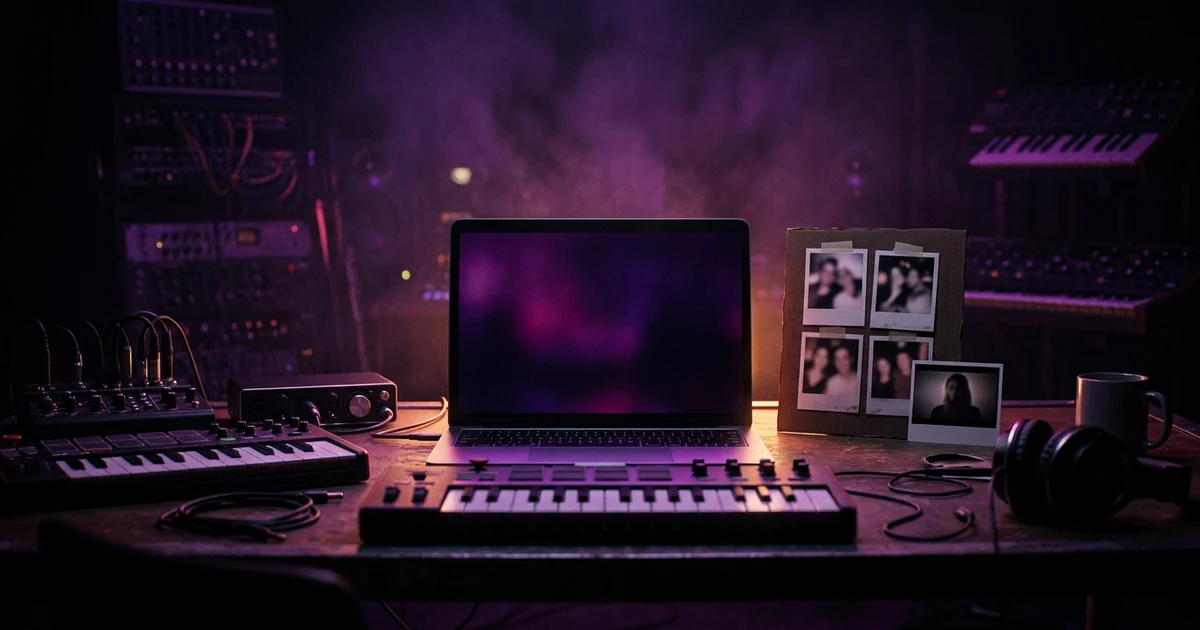
An EPK, or electronic press kit, is a single web page or PDF that gives a booker, journalist or playlist curator everything they need to judge your act in under a minute: a short bio, music they can play without leaving the page, press photos, a video, a few press quotes or numbers, and a booking contact. It replaces the printed press kit musicians once mailed out. Its job is not to tell your whole story. It is to make a busy stranger say yes, or at least reply, before they lose interest.
Your first 30-second storyboard is free. Plans from $19/month.
What does an EPK do for a musician?
The short answer: An EPK, or electronic press kit, is a single web page or PDF that gives a booker, journalist or playlist curator everything they need to judge your act in under a minute: a short bio, music they can play without leaving the page, press photos, a video, a few press quotes or numbers, and a booking contact. It replaces the printed press kit musicians once mailed out. Its job is not to tell your whole story. It is to make a busy stranger say yes, or at least reply, before they lose interest.
If you have ever sent a booker three separate links (Spotify, Instagram, a YouTube video) and a paragraph of explanation, you have already made a worse version of an EPK. The kit just puts those things in one place, in the order a stranger wants them.
The same term shows up in film, where it means a studio's pack of stills, clips and cast notes for the press. This guide is about the musician's version.
Who opens an EPK, and what are they doing?
Four kinds of people, each with a different question (a simplification, since roles overlap):
| Reader | What they are deciding | What they check first |
|---|---|---|
| Promoter or venue booker | Can this act fill a slot on my bill? | Sound, live proof, whether you have drawn a crowd anywhere |
| Journalist or blogger | Is there a story here? | The hook in your bio, any press already earned, a recent release |
| Playlist curator or radio | Does this fit my list? | The track itself, genre, release date |
| Sync or brand contact | Can I use this, and who do I ask? | Music, a clear contact, who owns the rights |
Assume they are skimming. A booker triaging a stack of submissions is not reading your bio for pleasure; they are looking for a reason to keep going or a faster reason to stop. Build the kit for that skim, not for a fan who already loves you.
What belongs in an electronic press kit?
These are the standard elements of a musician's kit. The order is the order a skimming reader needs them.
- One line on who you are. Genre, place, and the one hook that makes you specific. "Four-piece indie folk band from Leeds" is a start; add whatever is true and distinctive.
- Music, playable on the page. One or two tracks the reader can start with a click. Pick your best, not your newest, unless they are the same.
- Photos. Two or three press-quality shots, offered as downloads at high resolution, ideally in more than one shape (landscape, portrait, square) because outlets crop to their own layouts.
- Video. A clip that shows you in motion. We cover this one properly in do you need a video in your EPK.
- Bio, short and long. A short version (a few sentences) that you can paste into an email or a listing, and a longer one for writers. Write in the third person, because it will be copied into other people's articles.
- Press and numbers. Quotes from real coverage with the outlet named, streaming or follower counts if they are respectable, notable shows and collaborations. If you have none yet, skip the section.
- Contact. A booking email that goes to a person who replies. Add management or an agent if you have one.
Sample text for each of these, plus a template you can copy, is in electronic press kit examples for musicians. This page is the explanation; that one is the worked example.
Web page or PDF?
Both formats exist, and they do different things.
| Web page | PDF one-sheet | |
|---|---|---|
| Music and video | Plays on the page | Links out |
| Updating | Edit a line, it is live | Re-export and re-send |
| Forwarding | Send a link | Attach or print |
| Works on a phone | Only if you build it to | Often awkward to read |
| Best for | The default you send | Venues and press who ask for a file |
Start with the page. Keep the PDF as a one-page summary with the same photo, bio and links, for the person who asks for "something I can forward to my team".
If you want somewhere to host the page, a template builder or a hidden page on your own site works. Whatever you use, open it on your phone before you send it. Plenty of first looks happen on a phone, in a queue or on a train.
What makes a good EPK, and what makes a weak one?
The strong ones share a few habits:
- They put the music first. The reader should be able to press play before scrolling.
- They are specific. "Raw, emotional, genre-defying" says nothing. "Two guitars, one drum machine, songs about night shifts" says something.
- They are consistent. Photos, cover art, colours and video look like one act. A kit assembled from unrelated assets reads as unfinished.
- They are current. A kit whose newest show is two years old tells the reader you stopped.
The weak ones fail in predictable ways:
| Mistake | What the reader concludes | Do instead |
|---|---|---|
| A 600-word bio | Nobody here edits | Short version up top, long version below |
| Five unplayable links | Too much work | Embed the track on the page |
| Padding with empty sections | Not ready yet | Remove sections you cannot fill |
| Blurry or phone-snap photos | Not serious | Two good shots beat ten average ones |
| No contact, or a dead inbox | Cannot book you | One email address, checked daily |
| Claims with no source ("viral hit") | Probably inflated | Numbers and quotes with names and dates |
Where does a video fit?
Everything else in the kit is static. The bio tells a stranger what you sound like; the photo tells them how you look; the links ask them to go and check. A video is the only element that shows you in motion without making them leave the page.
If you have good live footage in decent light and sound, use it. Nothing beats real proof of performance. If you do not, a music video made from one of your own tracks is a reasonable stand-in, as long as you present it as a music video and not as a gig. You can make one from a finished song with an AI music video generator and no shoot. Keep it to roughly the strongest minute of the song, and put the best moment at the start because many readers will not reach the end.
If the same video also has to work for a release, the single release playbook covers cutting one render for both jobs.
How to build an EPK in an afternoon
- Pick the one track you most want a stranger to hear. Make sure it is the finished master.
- Choose two photos. If you have none you are happy with, fix that before anything else.
- Write the one-line description, then the short bio, then the long one. Write them in that order; the short one is the hardest.
- Collect proof. Pull real quotes, dates and numbers. Anything you cannot source goes.
- Get a video. Use live footage if it is good. Otherwise make a short music video from the track and label it as one.
- Assemble the page with the music at the top, then photos, video, bio, press, contact.
- Test it on a phone, then send it to one person who does not know your music and ask what they would do next.
Put a "last updated" date at the bottom and look at the whole kit again every time you release something, play a notable show or get a new piece of press. A kit that is accurate this month is worth more than a beautiful one that is a year out of date, because the person reading it may check the dates first.
How is an EPK different from promoting a release?
An EPK is a tool for pitching people who control a slot: a gig, a feature, a list. It is not the same thing as promoting a release to listeners, which is where promoting your music with a video and the broader artist persona work come in. Keep the same visual identity across your kit and your release campaigns, so they read as one artist. If you are a band rather than a solo act, a band promo video is the format to reach for.
So the answer to "what is an EPK" is short: it is the one page you can send to a stranger who can say yes. Build it so they can decide in a minute, and keep it up to date, because the one time you need it is the one time you do not want to be rebuilding it.
Melodious can turn a song into a music video for your kit: the brief and a storyboard are free, and you pay only when you choose to render the video.
Frequently asked questions
What does EPK stand for?
EPK stands for electronic press kit. It is the digital version of the press kit that bands used to mail to venues and journalists: one place that holds your bio, music, photos, video, press and contact details so a stranger can understand your act quickly.
What is the difference between an EPK and a website?
A website is for fans and covers everything. An EPK is for people who can say yes to you, such as bookers, editors and curators, and it is cut down to what they need to decide. Many artists build the EPK as a single hidden page on their site, or as a short PDF, and send that link instead of the homepage.
Do I need an EPK if I have no press or shows yet?
Yes, and it is more useful then. With no press quotes you lean on the music, one strong photo, a clear bio and a video. Leave out sections you cannot fill honestly rather than padding them. A short, confident kit beats a long one with empty headings.
Should an EPK be a PDF or a web page?
A web page is usually better because music and video play on the page and you can update a date or a track in a minute. Keep a PDF one-sheet as well for people who want to forward or print it. If you can only do one, make the page and make sure it works on a phone.
How long should an EPK be?
Short enough to scan in a minute. One screen of essentials at the top (one line on who you are, a track to play, a photo, a booking contact) with deeper sections below it. A reader should reach a decision before they reach the bottom.
Can I make an EPK video without filming anything?
Yes. If you do not have good live footage, you can generate a short music video from your own song and use that as the video in the kit. It will not prove you can play live, so label it as a music video rather than a performance, and say plainly when something is AI-generated.
Your press kit needs something that moves.
Bring one finished song. Melodious reads it, writes the brief and a storyboard for free, and you decide whether to render the video.
Start free