How Much Does a Music Video Cost? An Honest 2026 Breakdown
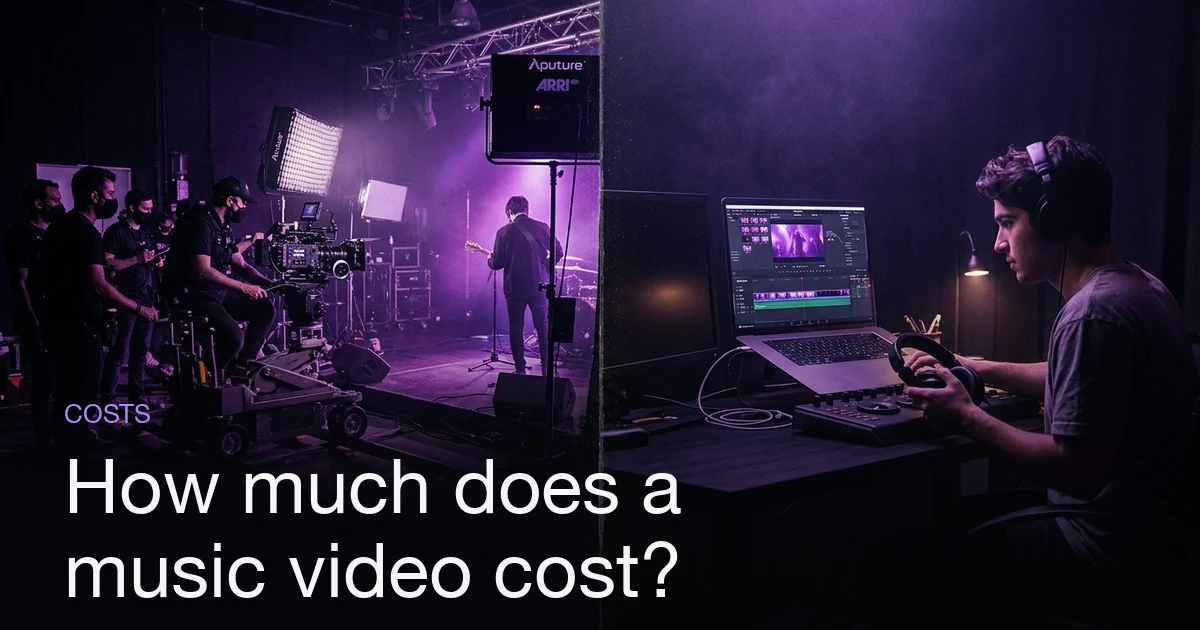
A music video costs anywhere from almost nothing to six figures, depending on how it's made. A DIY phone-and-free-editor video runs $0–$500. An indie shoot with a small crew typically lands between $1,000 and $10,000. A professional, label-grade production commonly runs $15,000 to $50,000, and marquee videos climb past $100,000. AI music video tools are the newest, lowest tier: you upload a song and generate a finished video for a fraction of a single shoot day, typically $19 to $100 for a finished cut. The right number depends on your goals, not a fixed price, so match the budget to whether you need a viral hit or simply a video for every release.
Plans from $19/month, cancel anytime. Starter makes one 30-second video a month.
What does a music video actually cost in 2026?
The short answer: A music video costs anywhere from almost nothing to six figures, depending on how it's made. A DIY phone-and-free-editor video runs $0–$500. An indie shoot with a small crew typically lands between $1,000 and $10,000. A professional, label-grade production commonly runs $15,000 to $50,000, and marquee videos climb past $100,000. AI music video tools are the newest, lowest tier: you upload a song and generate a finished video for a fraction of a single shoot day, typically $19 to $100 for a finished cut. The right number depends on your goals, not a fixed price, so match the budget to whether you need a viral hit or simply a video for every release.
"How much does a music video cost" has no clean answer because a music video isn't one product — it's a spectrum. The same three-minute song can be a $0 phone clip or a $250,000 cinematic set piece, and both are "a music video." What changes is who holds the camera, how many people are on set, and how many days go into the edit. If you're weighing making one yourself, our guide to making an AI music video covers the how; this piece covers the cost.
What drives the cost of a music video?
Almost every dollar in a filmed music video maps to one of these line items:
- Crew — director, director of photography, camera operators, gaffers, assistants. Usually the single biggest cost, because it's people paid by the day.
- Talent — the artist is free, but dancers, actors, extras, and a choreographer are not.
- Location and permits — a friend's garage is free; a rented studio or a permitted city street is not.
- Equipment — cameras, lenses, lighting rigs, grip gear, and stabilizers, owned or rented by the day.
- Post-production — editing, color grading, VFX, and motion graphics. A complex edit can cost as much as the shoot itself.
- Concept complexity — every extra location, costume, effect, or set piece multiplies all of the above.
- Runtime and market — a longer song means more setups and more edit hours, and day rates in a major city like LA or London run well above a small-market videographer's.
The pattern to notice: cost scales with people and days, not with the camera. A phone shoots beautiful footage; the humans on set and the hours in the edit are what cost money — which is exactly what the AI tier removes.
How much does a music video cost by production tier?
Here's the breakdown across the four ways artists make videos in 2026. These are widely-known market ranges, not precise quotes — your number depends on your city, concept, and who you hire.
DIY (phone + free software): $0–$500
You shoot it yourself on a phone or entry-level camera and edit in free software like CapCut, DaVinci Resolve, or iMovie. The cost is mostly your time, and a strong concept can still genuinely compete. The ceiling is real, though: without a crew or gear, ambitious shots (crane moves, complex lighting, multiple locations) are out of reach.
Indie shoot (small crew): $1,000–$10,000
You hire a small local crew — often a director/videographer who brings their own gear — for a day or two, maybe rent a location, and pay for a professional edit. In practice a videographer day rate is often $400–$800, with another $300–$800 for the edit, plus location and extras on top. One rung below this, a single freelancer booked through a marketplace like Fiverr or Upwork can shoot and cut a simple video for roughly $200–$2,000 — a real middle option between DIY and a full crew. The indie tier is the sweet spot for many emerging artists: enough production value to look intentional, without label-scale spend.
Professional / label-grade: $15,000–$50,000+
A full production company, named director, proper crew, professional talent, multiple locations, and a post pipeline with color grading and VFX. This is what most "official" major-label videos cost, and the top end pushes well past $100,000.
AI music video: a fraction of a single shoot day
The newest tier. Instead of a shoot, you upload your song to an AI tool, describe the video you want, and it plans a storyboard, generates the shots, and stitches them into a finished, audio-synced video — no crew, no location, no editor. With Melodious, Starter is $19/month for about 35 seconds of HD video and Artist is $97/month for a complete release video of about four minutes — a fraction of a single indie shoot day (what you actually pay per finished video is worked out separately). That's why it's become the practical option for artists who want a video for every release, not just the flagship single.
AI music video vs. a traditional shoot: what are you really trading?
A traditional shoot gives you real cameras, real performers, and a physical world AI can't perfectly replicate. If your concept demands a specific human performance, a live band, or a location that is the point, you need a shoot — that's what the higher tiers buy.
With an AI music video, you trade the camera for a conversation. You upload your track, pick a director style, describe your vision in plain language (one sentence and a song is enough to start), and the AI builds a storyboard shot by shot against your song's real structure. You can save a recurring character as a reusable asset so the same face holds across every scene, then generate — each shot becomes a keyframe, then an animated clip, then everything is stitched and synced to your audio. The full walkthrough lives in our guide to making an AI music video, and the MP3-to-video tool is the quickest on-ramp for an existing track.
The leverage is iteration. A shoot costs the same whether you love the result or not. With AI, every creative decision is cheap and reviewable before you generate.
Cost comparison: music video by production type
| Production type | Typical cost | What you get | Time to a finished video | Best for |
|---|---|---|---|---|
| DIY (phone + free editor) | $0–$500 | Self-shot footage, basic edit | A day or a weekend | First-time artists, tight budgets |
| Indie shoot (small crew) | $1,000–$10,000 | Small crew, one location, pro edit | 1–3 weeks | Emerging artists wanting polish |
| Professional / label-grade | $15,000–$50,000+ | Full crew, named director, VFX, post | Weeks to months | Flagship singles, label releases |
| AI music video | $19–$100 per finished video | AI storyboard, generated shots, audio-synced cut | One session | A video for every release; fast iteration |
The table makes the real trade-off visible: it's less about cheap versus good than about the outcome you're buying. A flagship single may justify a five-figure shoot; a steady stream of releases that each need a video is what the DIY and AI tiers are for.
Common mistakes when budgeting a music video
| Mistake | What happens | Do instead |
|---|---|---|
| Assuming a bigger budget guarantees more views | You overspend on production the song can't recoup | Spend on the concept and distribution, not just polish |
| Ignoring post-production in the quote | The "shoot day" price doubles once editing is added | Get editing, color, and VFX quoted up front |
| Paying for a shoot on every release | Cost blocks you from posting consistently | Reserve shoots for flagship singles; use DIY or AI for the rest |
| Overlooking the AI tier entirely | You skip the cheapest route to a finished video | Weigh AI alongside DIY before you commit to a shoot |
| Booking a crew before locking the concept | Expensive reshoots when the idea changes on set | Lock the concept (or storyboard) before spending |
Each of these mistakes shares one root cause: decide what the video needs to achieve before you decide what it costs.
How do you choose the right budget for your release?
Work backwards from the goal, not the price tag. Ask three questions:
- What's this video's job? A flagship single with a label or marketing push behind it can justify an indie or pro shoot. A catalog track, a lyric video, or a monthly release cadence does not.
- What can you afford to repeat? The real cost of consistency isn't one video — it's twelve. If you want visuals for every release, only the DIY and AI tiers scale to that cadence.
- Does the concept require a camera? A specific human performance or a real location may need a shoot. A stylized, narrative, or atmospheric video often doesn't — and that's where an AI tool fits.
For most independent artists in 2026, the answer isn't one tier — it's a mix: save the shoot budget for the single you're betting on, and lean on free and low-budget methods for everything else.
Ready to skip the five-figure invoice? Pick a Melodious plan (from $19 a month), pick a director style, and turn your song into a finished, audio-synced music video with a built-in demo track — so you can see exactly what the AI tier delivers before you spend on a shoot.
Frequently asked questions
How much does a music video cost on average?
There's no single average because the range is enormous. A DIY video can cost $0–$500, an indie shoot usually runs $1,000–$10,000, and a professional label-grade video commonly costs $15,000–$50,000, with high-end productions passing $100,000. AI-generated music videos sit at the bottom of the range, typically $19 to $100 for a finished cut.
Why are professional music videos so expensive?
The cost is mostly people and time, not the camera. A pro shoot pays a director, a director of photography, a full crew, actors or dancers, location and permit fees, equipment rental, and days of post-production editing and color grading. Each of those is a line item that scales with the ambition of the concept.
Can you make a good music video on a small budget?
Yes. Plenty of memorable videos were shot on a phone or a single-camera indie setup for a few hundred dollars. The trick is a strong concept and tight editing rather than expensive gear. AI music video tools push the floor even lower by handling the shot planning, imagery, and editing for you.
How much does an AI music video cost?
Far less than any filmed option. Instead of paying a crew for a shoot day, you upload your song and the AI plans a storyboard, generates the shots, and syncs everything to your audio. With Melodious, Starter is $19/month for about 35 seconds of HD video and Artist is $97/month for about four minutes, a full-length release video, against $1,000+ for the cheapest real shoot.
What's the cheapest way to make a music video?
The two cheapest routes are a DIY phone shoot with free editing software, and an AI music video tool. DIY costs your time and gives you full creative control; an AI tool trades the camera for a chat-driven workflow that produces a finished, audio-synced video without a shoot, editor, or crew.
Does a more expensive music video get more views?
Not reliably. Budget buys production polish, but views come from the song, the concept, and distribution. Many low-budget and AI-made videos outperform expensive ones because the idea landed. Spend where it changes the outcome, and don't assume a bigger budget guarantees a bigger audience.
Make your next music video in Melodious
Attach your song and an AI director builds the storyboard scene by scene — with characters that stay consistent the whole way through. Plans from $19/month, cancel anytime. Starter makes one 30-second video a month.
Make your music video